Friday, January 31, 2020

Behind The Victorian Gold Revival

For the best part of 50 years Victoria’s historically fecund gold fields have been a basket case, given lack of government support and disastrous big-ticket attempts to revive the underground Bendigo and Ballarat mines.

Now, the region is in the midst of a latter day gold rush, thanks to the efforts of Canadian miner Kirkland Lake Gold ((KLA)) at developing the Fosterville mine into a 600,000 ounce a year, 46 grams a tonne monster.

“There’s never been a better time to be in gold right now in Victoria,” says Kalamazoo Resources’ ((KZR)) executive chairman Luke “Sco-Mo” Reinehr. “Kirkland Lake changed everything.”

Fosterville was considered a low grade and difficult mine until legendary Canadian mining investor Eric Sprott got involved with Kirkland Lake, resulting in an aggressive drilling program that uncovered riches much deeper than expected.

Reinehr notes that at Fosterville the lustrous stuff is also being produced at an “all in” cost of $318 an ounce, which with a circa $2100 an oz Aussie gold price implies the mine is spitting out more than $1 billion of free cash flow annually.

How good is that!

Can Kalamazoo emulate the Kirkland Lake miracle? Well, Sprott himself thinks so, this month taking up $4m of Kalamazoo shares in a placement. The TSX listed Novo Resources, of which Sprott is a director, took up a further $4m.

Enthusiasm for Victorian gold among deep pocketed folk is proving more infectious than the mysterious coronavirus in a Chinese transit lounge.

Last year, fellow Victorian explorer Navarre Minerals ((NVR)) raised $9m in a share placement to Canadian fund manager 1832 Asset Management, which became a 7% shareholder.

Other notable investors along for the Navarre ride are Kirkland Lake (with 10% of the register) and the Victor Smorgon Group (9%).

Gina Rinehart’s Hancock Prospecting has invested $7.9m in Catalyst Metals ((CYL)) which now bears a chunky $250m market cap.

Meanwhile Chalice Gold Mines ((CHN)) is 17% owned by exec chairman Tim Goyder, brother of erstwhile Wesfarmers and AFL supremo Richard.

Founded by “proud Victorian” Luke and Matt Reinehr, Kalamazoo had its roots in the Pilbara.

But they had closely monitored their own turf and cottoned on that Castlemaine Gold – the operator of a Ballarat mine acquired from Lihir Gold in 2008 – was being forced to relinquish its ground because it was not fulfilling it minimum exploration spending commitments.

Castlemaine Gold paid $10m for the Ballarat mine, after Lihir (now Newcrest) sunk $700m into it.

Reinehr says Castlemaine Gold’s new owner, Lion Gold had been “sucking every dollar out of Castlemaine and that means ending exploration.”

Not only did Kalamazoo win the ground for no more than an application fee, but the friendly Castlemaine also bestowed a database with 300 million pieces and the results of an 80,000 metre diamond core program.

“If someone were to buy that today I would hate to think what it would cost, the diamond samples have a $20m replacement value,” Luke Reinehr says.

Similarly, the unlisted Centennial Mining gave up its South Muckleford tenements (also known as South Maldon) and Kalamazoo hoovered these up as well.

“We now control the third largest and seventh largest historical gold fields in Victoria,” Reinehr declares.

Kalamazoo’s 445 square kilometres of prospects are in the greater Bendigo zone, which historically has produced 60 million ounces at an average 15 grams a tonne – 100 times higher than the global average

Castlemaine hosts Forest Creek: “site of the world’s richest shallow alluvial goldfield ever.” There’s even a plaque to prove it.

The company isn’t interested in the alluvial stuff, but is dead keen on finding the source of the gold in the ground.

Reinter acknowledges that to find “the next Fosterville”, the company has to spend some serious dollars. The starting point is a 10,000 metre program using diamond drilling, at a cost of $2.5m.

Just before Christmas, the company reported “exceptional” results at its Mustang prospect, including a 1.42 metre intersect grading 261 grams a tonne (with a sniff of visible gold at 1916 g/t).

The Sprott news sent Kalamazoo shares up as much as 45%, with the placement struck a 24% premium (40c a share).

Earlier, Kalamazoo raised $7m by selling a sold a WA prospect called Snake Well to former Asciano chief Mark Rowsthorn and his business partner Nathan Mitchell.

Given the fancy headline number, Kalamazoo has been allowed to pay in instalments.

Dual-listed on the Frankfurt exchange, Kalamazoo shares remain tightly controlled by the Reinehrs, who hold 32% post placement (the Sprott and Novo camps each hold 8%).

In the meantime, the Victorian government is due to announce the winner of a new tenement grouping called Block 4, which abuts the Fosterville mine. To describe the tender as hotly competed is somewhat of an understatement, with all of the key players expected to have competed in the Dutch auction process.

“We are going in hard we think we have a good chance,” Reinehr says.

- Source, FN Arena

What Does The Lack Of Institutional Ownership Tell Us About dynaCERT?

Institutional investors often avoid companies that are too small, too illiquid or too risky for their tastes. But it’s unusual to see larger companies without any institutional investors.

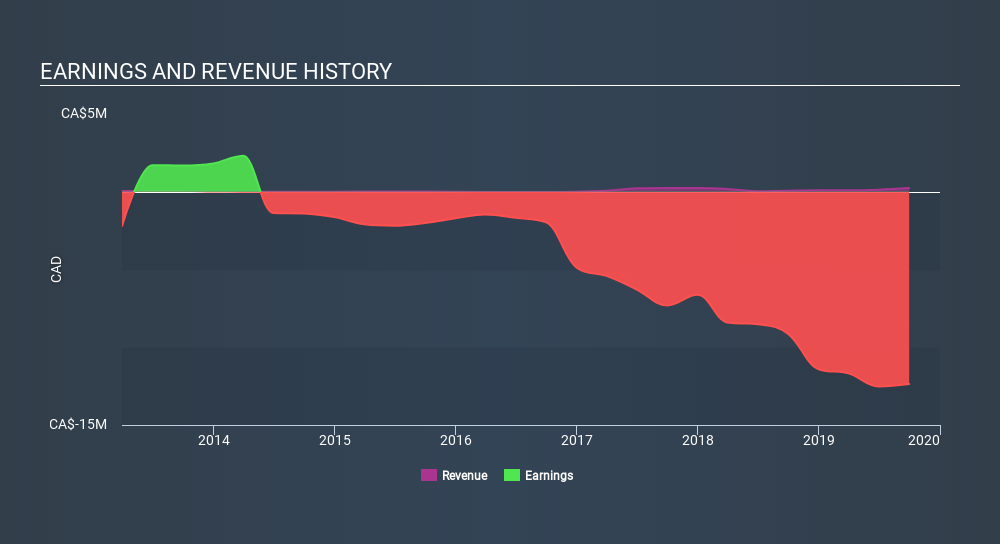
There could be various reasons why no institutions own shares in a company. Typically, small, newly listed companies don’t attract much attention from fund managers, because it would not be possible for large fund managers to build a meaningful position in the company. Alternatively, there might be something about the company that has kept institutional investors away. Institutional investors may not find the historic growth of the business impressive, or there might be other factors at play. You can see the past revenue performance of dynaCERT, for yourself, below.


TSXV:DYA Income Statement, January 22nd 2020

Hedge funds don’t have many shares in dynaCERT. Eric Sprott is currently the largest shareholder, with 8.3% of shares outstanding. The second largest shareholder with 2.1%, is Raymond Hoffman, followed by Elliot Strashin, with an ownership of 2.1%. Elliot Strashin also happens to hold the title of Member of the Board of Directors.

Our studies suggest that the top 10 shareholders collectively control less than 50% of the company’s shares, meaning that the company’s shares are widely disseminated and there is no dominant shareholder.

Researching institutional ownership is a good way to gauge and filter a stock’s expected performance. The same can be achieved by studying analyst sentiments. While there is some analyst coverage, the company is probably not widely covered. So it could gain more attention, down the track.

- Source, Simply Wall St, read the full article here

Tuesday, January 28, 2020

Galleon Gold Closes Shares for Debt Settlement for Interest Owed to Eric Sprott

Gold Corp. (TSXV: GGO) (the "Company" or "Galleon Gold") announces that it has closed its previously announced debt settlement agreement (see press release January 17, 2020). Eric Sprott, through 2176423 Ontario Ltd., a corporation that is beneficially owned by him, agreed to settle an aggregate amount of $82,177 for interest earned on a Galleon Gold Debenture (the "Debt Settlement"). The Debt Settlement was settled by the issuance of 1,027,218 common shares at a deemed price of $0.08 per share.

The securities issued pursuant to the Debt Settlement will be subject to a four-month hold period commencing on the date of issuance.

Mr. Sprott now beneficially owns and controls 71,248,950 shares of the Company representing 27.9% of the outstanding common shares.

Friday, January 24, 2020

Generation Mining Announces $8 Million Private Placement of Units Including a $5 Million Investment from Eric Sprott

Generation Mining Limited (CSE:GENM) ("Gen Mining" or the "Company") is pleased to announce that it has entered into an agreement with Haywood Securities Inc. and Mackie Research Capital Corporation as co-lead underwriters and joint-bookrunners on behalf of a syndicate of underwriters including PowerOne Capital Markets Limited and Raymond James Ltd. (collectively, the "Underwriters"), pursuant to which the Underwriters have agreed to purchase, on a "bought deal" private placement basis, 15,385,000 units of the Company (the "Units") at a price of C$0.52 per Unit (the “Issue Price”), for total gross proceeds of C$8,000,200 (the "Offering"). Each Unit will consist of one common share (a “Common Share”) in the capital of the Company and one-half (1/2) of one common share purchase warrant (each whole common share purchase warrant, a “Warrant”) of the Company. Each Warrant shall be exercisable to acquire one Common Share (a “Warrant Share”) at a price per Warrant Share of C$0.75 for a period of 24 months from the closing date of the Offering.

Gen Mining is pleased to announce that Eric Sprott has agreed to purchase C$5,000,000 of the Offering. On completion of the Offering, Eric Sprott will own approximately 8.84% of the Company on a non-diluted basis and approximately 12.70% on a partially diluted basis.

The Company has granted the Underwriters an option to purchase up to an additional 25% of the Offering in Units (the "Underwriters’ Option"), exercisable in whole or in part at any time up to 48 hours prior to the closing date.

The net proceeds from the sale of the Units will be used for exploration and development of the Company’s Marathon Palladium Project, as well as working capital and general corporate purposes.

The Offering is expected to close on or about February 13, 2020 and is subject to certain conditions including, but not limited to, the receipt of all necessary approvals including the approval of the Canadian Securities Exchange and the applicable securities regulatory authorities. The Units to be issued under the Offering will be subject to a hold period in Canada expiring four months and one day from the closing date of the Offering.

In connection with the Offering, the Underwriters will receive: (i) a cash commission of 6.0% of the gross proceeds of the Offering, excluding gross proceeds from the issuance of Units to Eric Sprott for which a commission of 4.0% of such gross proceeds is payable by the Company to the Underwriters; and (ii) that number of non-transferable compensation options (the “Compensation Options”) as is equal to (a) 6.0% of the aggregate number of Units sold under the Offering, excluding those Units sold to Eric Sprott, and (b) 4.0% of the aggregate number of Units sold under the Offering to Eric Sprott. Each Compensation Option is exercisable into one Common Share of the Company at the Issue Price for a period of 24 months from the closing date of the Offering.

The securities offered have not been registered under the U.S. Securities Act of 1933, as amended, and may not be offered or sold in the United States absent registration or an applicable exemption from the registration requirements. This press release shall not constitute an offer to sell or the solicitation of an offer to buy nor shall there be any sale of the securities in any State in which such offer, solicitation or sale would be unlawful.

Tuesday, January 21, 2020

Eric Sprotts Take on the Recent Gold and Silver Trading Action


Eric Sprott takes time out of his South American fishing trip to discuss the week’s gold and silver news with host Craig Hemke.

Friday, January 17, 2020

Eric Sprotts Assessment on Initial Gold and Silver Trading Action in 2020


Eric Sprott joins us from Antarctica and offers his assessment of the initial gold and silver trading action as we begin 2020.

Saturday, January 4, 2020

Eric Sprott Updates Viewers About the Mining Sector


Eric Sprott the economic events of the past week while also providing updates on a few, key mining companies.

- Source, Sprott Money

Tuesday, December 31, 2019

Gold's Rise and the Dollar's Demise


Rick Rule, president and CEO of Sprott U.S. Holdings Inc., shares how the worldwide explosion of negative yielding debt shapes his bullish outlook on gold. 

He examines the impact that a "war on savers" has on the global financial system and on precious metals, and he shares his ideas on where inflation fits into the equation. 

Rule explains his outlook for the future of the monetary system by analyzing the evolving relationship between cryptocurrencies, precious metals, and fiat currencies.

- Source, Real Vision

Saturday, December 21, 2019

Craig Hemke: Exchange For Physical?

Two years ago, following a surge in the use of “Exchanges For Physical” by traders at the COMEX, Eric Sprott asked me to begin tracking and recording the daily totals for this practice as posted by the CME. It’s time for an update.

First, let’s attempt again to discern what the heck an “exchange for physical” really is, because the truth of the matter is, no one really knows. When we first wrote about EFPs back in April of 2018, this was the best summary explanation we could find:

So, these are “ex-pit transfers between two parties”. OK. If that’s the case, then EFPs are best categorized as a swapping of positions between two parties. Given the volume of these transfers each day, it’s safe to assume that the two parties in question here are almost always Bullion Banks. And what are “Bullion Banks”? These are the banks that manage the physical delivery market in London…and they operate hand-in-glove with their trading desk operations on the COMEX in New York.

(By the way, the conspiracy to rig and manipulate prices between London and New York trading is precisely what the U.S. Department of Justice is currently investigating under the RICO statutes…an investigation that has already yielded six indictments, including the former head of JP Morgan’s global precious metals desk, Michael Nowak. It’s noteworthy that up until his indictment, Nowak also proudly served on the board of directors of the LBMA. Read more here: https://www.zerohedge.com/markets/abject-corruption-exposing-financial-political-complex-protecting-its-own-gold-manipulation)

Anyway, back to the EFPs. Though this practice of “ex-pit transfer” has been around for decades, the use of this scheme has increased dramatically in the past several years, possibly coinciding with a similarly dramatic increase in total contract issuance and open interest.

How does the CME itself define an EFP? Here’s a link, an excerpt of which is pasted below: https://www.cmegroup.com/trading/metals/precious/g…


Note the last line above. “EFP is a key component in pricing OTC spot gold”. Dutch money manager Gijsbert Groenewegen offered to provide his expertise and insights to this process back in 2018, and back then, he suggested that the dramatic surge in EFP use was also a tool for Banks to directly impact price. Groenewegen theorized that The Banks do, in fact, now use EFPs as a means to control prices off-exchange and through the deliberately-opaque OTC markets. This is worth considering, and you can read his article here: https://www.tfmetalsreport.com/blog/8942/guest-pos…

But let’s get back to the sheer volume of EFPs at present, because in the end, I believe it helps to reveal again the utter scam, sham, and fraud of the current digital derivative and fractional reserve pricing scheme.

From the CME Group’s own website, it is explained that futures contracts and EFPs are utilized by “gold traders” who “frequently trade OTC with Banks to hedge gold transactions”. OK, that sounds legitimate. You’ve a big position and you’d like to hedge it? Go right ahead...

- Source, Craig Hemke via Eric Sprott's, Sprott Money

Tuesday, December 17, 2019

Silver and the Miners Wait Patiently for Gold

The Fed surpasses expectations for more QE to address potential liquidity issues in the repo market around year-end. This means interbank funding issues are getting worse, requiring ever more stimulus. Meanwhile, Trump announces a phase one trade deal with China “in principle”, which means nothing substantive has been agreed whatsoever. Yet, the stock market eats it up and we head to new highs. Meanwhile, the bond market takes a hit, with the 10-year yield rising back up to 1.95%.


It is no surprise that Gold, despite setting a marginal higher high yesterday, ended the day near its low.


Silver didn’t fare much better, although it did close up slightly for the day and relative to the previous close.


Miners did not escape the pain but still continue to outperform the metals. The clear standout recently has been SILJ, the junior miners ETF. It came within a whisker of its September peak at 11.57 before falling back. So while Gold and Silver continue to drift lower in their bullish flag patterns, SILJ is testing its highest level since May 2018. Unfortunately for SILJ, it also hit a negatively divergent higher high yesterday, which could signal trouble in the very short-term.


The bigger issue is that although Silver hit a positively divergent lower low this week, according to its daily RSI and both MACDs, Gold has yet to match that feat. While Silver and the miners can continue to outperform Gold, it is difficult but not impossible to see the sector move materially higher near-term without Gold establishing a clear trough. On top of that, the risk is that the rise in stocks and bond yields may have some momentum into year-end, weighing further on the metals and miners.

On the other hand, much of the good news has now been priced into stocks. The Fed has announced it will paper over any liquidity problems through year-end, and we got a trade deal in principle with China. It is not clear to me what the next catalyst will be to justify further increases in stocks and bond yields.

Simply put, we could see further downside pressure on the metals and miners in the next two to three weeks, but if and when we get that positively divergent lower low in Gold, below 1446, followed by a higher high above 1492, then we can look forward to higher highs across the sector. My preferred target for Gold on the downside has been in the low 1420s for quite some time. That represents a 50% retracement of the entire rally from 1267 to 1566. A negatively divergent peak in the 10-year yield above 1.97% wouldn’t hurt either.

December has been a very kind month to Gold in each of the past four years, but once we get that bottom in Gold, it is Silver and especially SILJ that I will be focusing on to the upside.

- Source, David Brady via Eric Sprott's, Sprott Money

Monday, December 2, 2019

Eric Sprott: Precious Metals Market and Mining Industry Update


Legendary Canadian investor Eric Sprott discusses the precious metals markets and the mining industry. He also answers listener questions regarding a few specific mining companies.

- Source, Sprott Money